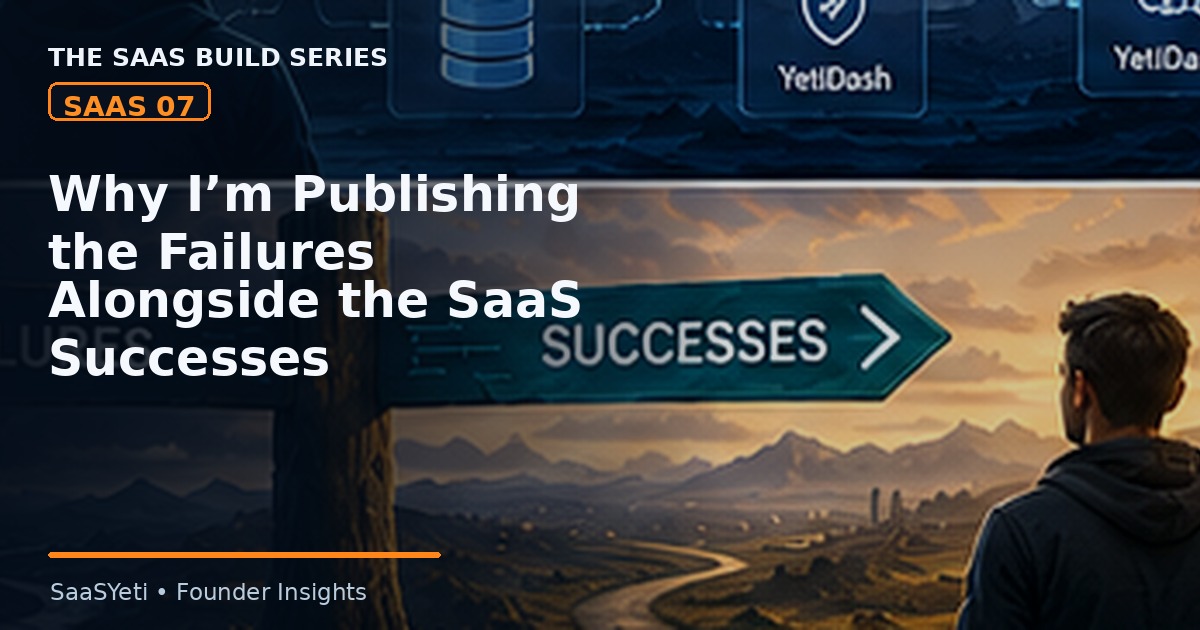
Why I’m Publishing the Failures Alongside the SaaS Successes
Founder stories often become cleaner after the fact. SaaSYeti is deliberately keeping the wrong turns, abandoned products and technical mistakes in the public record.
Founder stories become too clean
Most founder stories become much cleaner after the fact. Bad ideas disappear. Broken versions are forgotten. Abandoned products are quietly removed. Confusing experiments become a neat sentence about learning what the market wanted.
That is not how building software feels while you are doing it. It is messy. You misunderstand problems, build things that seemed sensible at the time, add features that later become liabilities and sometimes create something that works technically only to realise the correct business decision is to stop using it.
I have decided those moments belong in the SaaSYeti story too. If I only publish the successful parts of building SaaS with AI, I would be documenting a process I do not recognise.
AI makes failure faster too
AI speeds up prototypes, features and changes. But speed applies to bad decisions too. AI can help you build the wrong thing faster.
You can take a weak idea and give it a polished interface, automate a workflow that should have been removed, create an impressive dashboard around information nobody needs and keep adding capabilities long after the original purpose becomes unclear.
When building gets faster, reflection has to get better.
AI does not only help you build useful things faster. It can help you build the wrong thing faster.
Success-only stories teach the wrong lesson
If every product launches successfully, every customer loves it and every strategic decision proves correct, the obvious lesson is that experienced founders simply know what to do. They do not.
Experience helps people recognise some patterns earlier, but decisions are still made with incomplete information. The difference is often not avoiding mistakes entirely; it is recognising them sooner and responding properly.
YetiGrowthOS is a good example
GrowthOS was ambitious: an AI-powered operating system that understood products, customers, decisions, lessons, tasks, integrations and business knowledge. Significant parts worked. Real data flowed into it. Then I stopped.
That could be hidden. It would also erase the most useful lesson: the system working technically did not automatically make it worth continuing.
Failure is not always something breaking
Software failure is not only a crash or corrupted database. Some failures are quieter: a product solves a problem that is not important enough, a feature adds more complexity than value, a service duplicates something you already own, a clever architecture creates too much maintenance or a workflow functions perfectly but customers do not care about it.
Nothing necessarily breaks. The failure is in the assumption.
Sometimes stopping is the successful decision
I am cautious about using the word failure too broadly. If I discover a product will consume more time than the value it creates, stopping is sensible. If two applications should become one, retiring one is sensible. If ChatGPT already performs an internal task better than custom software I am maintaining, removing my software is sensible.
The mistake would be continuing because I am emotionally attached to what I built.
Building in public should include changing your mind
Once you announce something publicly it can feel as though you have made a promise. You show progress, people react and time gets invested. If the idea later stops making sense, changing direction can feel embarrassing.
It should not. A public build journey that never includes changing your mind is probably not showing the full process. Markets change, technology changes, AI capabilities move quickly, customer feedback changes assumptions and your own experience changes what you value.
A public build journey that never includes changing your mind probably is not showing the full process.
I want the journey to be useful, not impressive
I could document SaaSYeti by counting products, showing dashboards and announcing features. That would look impressive for a while and become boring quickly.
The more useful questions are: why did I build this? What did I expect? What happened? What broke? What was harder than expected? What did people actually use? What did I regret adding? What did I remove? What would I do differently?
Mistakes become valuable when they are specific
Generic founder lessons such as “listen to customers” or “focus” are almost useless without context. Specific lessons are better: I built a system that duplicated capabilities I already had. I created too many standalone applications before thinking about shared services. I underestimated the maintenance cost of rapid AI development. I sometimes added features because they were easy rather than important.
Specific mistakes allow somebody else to recognise the pattern in their own work.
The public record helps me too
Publishing the journey creates memory. When I document why I stopped a project, I preserve the decision. When I explain why an architecture became a problem, I make the pattern easier to recognise later. When AI accelerates the number of experiments, without a record lessons can become disconnected memories. With a record, they become reusable knowledge.
Transparency has limits
Publishing failures does not mean publishing everything. Customer information remains private. Security-sensitive details remain private. Credentials remain private. Private conversations remain private. The purpose is learning, not confession.
I also do not want failure theatre. Sometimes a bug is just a bug. Sometimes an idea simply did not work. The interesting question is whether there is a lesson worth carrying forward.
What changed because of it?
This is the test I want to use. A mistake matters if it changes future behaviour. If maintenance became a problem, architecture should change. If GrowthOS became too complex, I should not immediately create another giant internal platform. If community feedback matters, I should use it when it conflicts with my assumptions.
Failure becomes useful when it changes the next decision.
Why publish the failures?
Because the failures explain the successes. They reveal the real cost of experimentation, help other builders recognise similar traps, create a memory of decisions and make the public journey credible.
I do not want SaaSYeti to become a museum of polished screenshots with all the interesting parts removed. The products I stopped, the integrations that taught me something and the systems I overcomplicated are not separate from the story. They are the story.
The failures explain the successes.
Bugs deserve to be part of the story too
There is another kind of failure that almost every software builder recognises: the ridiculous bug. A date suddenly appears as 1970. A button does nothing. A patch expects the wrong version. An email reports that it was sent but never arrives.
These moments are frustrating, but they matter because they counter one of the biggest misconceptions around AI coding. AI does not turn software development into a straight line. There is still investigation, testing, rollback and unexpected interaction between systems. Sometimes AI identifies the cause immediately; sometimes it confidently suggests the wrong one. The lesson is not that AI failed. The lesson is that software still needs evidence.
There is a difference between failure and waste
An experiment does not become wasteful merely because it ends. A prototype that reveals a bad assumption can be valuable. A feature that proves users prefer a simpler workflow can be valuable. A project that teaches you what not to centralise can influence several later products.
Waste is repeating the same mistake after the lesson is clear. The goal is not to eliminate failed experiments; that would probably mean avoiding experimentation. The goal is to make sure failed experiments buy useful information.
This founder series documents the practical realities of building, operating and evolving SaaS products with AI — including the mistakes, maintenance and changes of direction that polished launch stories usually leave out. Follow the wider SaaSYeti Journey or see the community influencing what gets built next.