
I Stopped Using ChatGPT as Just a Coding Assistant
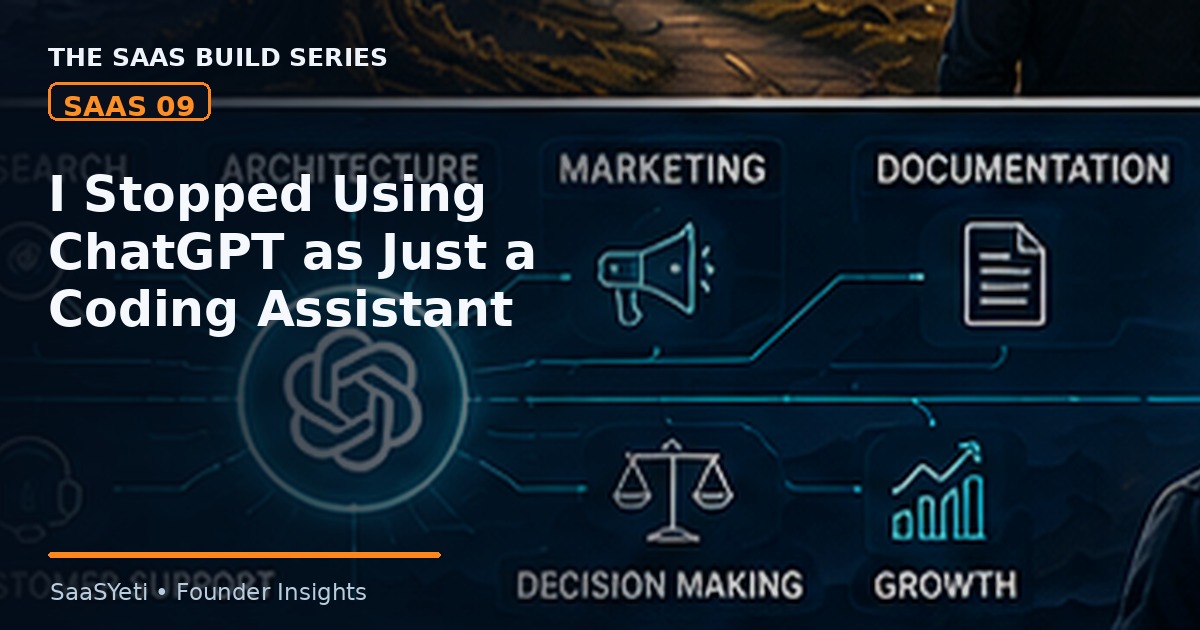
ChatGPT began as a faster way to write and fix code. Its larger value appeared in product strategy, architecture, debugging, research, marketing, documentation and deciding when not to build.
Coding was the easy entry point
When I first started using ChatGPT seriously for software development, the obvious use case was code: write this PHP function, fix this MySQL query, create this admin page, explain this error, add this feature.
That alone changed how quickly I could build software. But over time something more important happened. I stopped thinking of ChatGPT as a coding tool and started using it across almost every stage of building and operating SaaS: product ideas, architecture, feature decisions, debugging, documentation, marketing, customer communication, research, pricing, positioning, content, community strategy and deciding when not to build something.
Should we build this became more important than how
“How do we build this?” assumes the decision has already been made. “Should we build this?” keeps the decision open.
When an idea comes up now, I can explore it first. Who is it for? What problem does it solve? Do I already have an application that could handle it? Could it be a feature rather than another product? Could a shared service provide the capability? Would ChatGPT itself already solve enough of the problem?
Those questions can change the entire direction before a line of code exists.
AI became a product-thinking partner
Product development is full of assumptions: users will understand the interface, they want a particular feature, a workflow makes sense, the problem is important and the pricing is reasonable.
AI gives me a way to challenge those assumptions. I can ask it to argue against the idea, identify what is confusing, find the hidden maintenance problem or explain what a sceptical customer might say. The AI does not make the decision, but it can make the decision harder to make lazily.
Debugging changed too
When something goes wrong, I can bring the error, relevant code, expected behaviour and actual result into a conversation. AI can help reason across PHP, JavaScript, MySQL, server configuration, API responses, email delivery, permissions and application state.
But AI is not a magic debugger. It can sound confident when it is wrong. Logs, real files, database structure, version numbers and testing still matter. The quality of diagnosis improves dramatically when AI can inspect what is actually there rather than what I vaguely remember.
The conversation became part of the development environment
Traditional development starts by finding code, changing code and seeing what happens. AI adds another possible sequence: describe the goal, inspect the system, reason about the impact, make the change and verify it.
That reasoning step can be more valuable than the generated code, especially as applications become more complex.
Documentation became more realistic
Documentation is easy to postpone because a new feature always feels more urgent. AI reduces the friction. Application summaries, setup instructions, patch notes, architecture explanations and user guides can be drafted from real product information and reviewed.
For a solo founder operating many applications, documentation becomes a form of external memory.
Marketing became part of the same workflow
Once a SaaS works, people still need to understand it. What should the sales page say? What is the main benefit? Who is it really for? What objections exist? How should an email explain it? What should a Facebook post focus on?
Generic context produces generic AI marketing. Real context — why the product was built, what changed, what users said, what failed and what makes it different — produces much more useful communication.
The best marketing material often comes from development
A bug can become a lesson, a product decision can become an article, a failed system can become a founder story and a community discussion can become a case study. Development itself creates marketing material because real decisions are more interesting than invented claims.
That is what this SaaS Build Series is doing. The experiences are mine. AI helps organise and express them.
AI helps me think across products
As SaaSYeti grew, a new idea stopped existing in isolation. If I add something to one product, I need to consider whether another product already does it, whether email should be handled by YetiMail, access by YetiMembers, tracking by YetiLink Manager or research by a shared service.
A traditional coding assistant might simply build what I ask for. A broader AI workflow can stop and ask whether the capability belongs somewhere else.
AI became a way to recover context
When you work on many projects, context disappears quickly. You may remember the purpose of an application but not exactly how one integration works. AI can help rebuild understanding from snapshots, documentation and previous records.
I do not need to personally remember every function. I need to preserve enough accurate information that the system can be understood again. AI is very good at helping understand what is preserved; it is less good at recovering what was never recorded.
It helps me write better questions
Often the most important thing is not getting an answer but identifying the right question: why are users abandoning this page? Why am I maintaining this product? Why is this feature separate? Why am I building another application?
A conversation that prevents a bad decision can be worth more than a thousand lines of generated code.
A conversation that prevents a bad decision can be worth more than a thousand lines of generated code.
The relationship changed from command to collaboration
Early AI use can be transactional: write this, fix this, generate this. The deeper value appears when it becomes iterative: here is what I am trying to achieve, here is what exists, challenge the idea, inspect the real system, identify the safest implementation and tell me what could break.
I still make the decision and own the consequences, but the path to the decision is better informed.
There are things I do not want AI deciding
Using AI broadly does not mean handing over responsibility. Whether a product should be shut down, customer data moved, pricing changed, a security risk accepted or a marketing claim published all require human ownership.
AI can analyse, challenge and suggest. Responsibility stays with the person operating the business.
The skill is becoming context management
If I ask “improve my SaaS,” the answer can only be generic. If the AI knows what the application does, who uses it, how it is built, what happened recently, what users reported, what other products exist and what the business is trying to achieve, the conversation becomes dramatically more useful.
Better context produces better assistance.
The code is only one part of the conversation
If someone asked how I use ChatGPT to build SaaS, saying “it writes code” would be accurate but would miss most of the story. It helps me think about what I am building, why I am building it, where it belongs, what might go wrong, how to explain it, how to maintain it and why I might stop.
I did not stop using ChatGPT for coding. I stopped limiting it to coding.
Research, pricing and community became conversational too
Research used to mean opening dozens of tabs and trying to hold competitor pages, documentation, reviews and pricing in my head. AI can help organise that information into patterns: where customers complain, what products all assume, which workflows remain awkward and what a simpler alternative might look like. Reliable sources still matter, but turning research into decisions is faster.
Pricing benefits from the same treatment. AI cannot know with certainty what customers will pay, but it can challenge weak logic: what the service costs, what alternatives exist, what should be limited, what a premium plan needs to justify and whether an offer damages recurring revenue.
Community management connects as well. Individual comments can be grouped into repeated problems and possible experiments. The value is not that AI replaces conversation; it helps me notice patterns in conversation that might otherwise remain scattered.
This founder series documents the practical realities of building, operating and evolving SaaS products with AI — including the mistakes, maintenance and changes of direction that polished launch stories usually leave out. Follow the wider SaaSYeti Journey or see the community influencing what gets built next.