
I Built Dozens of SaaS Tools With AI. Coding Wasn’t the Hard Part.
AI can make building a SaaS application remarkably fast. But every new app creates another database, dependency, integration, backup and responsibility. Operating the software became harder than creating it.
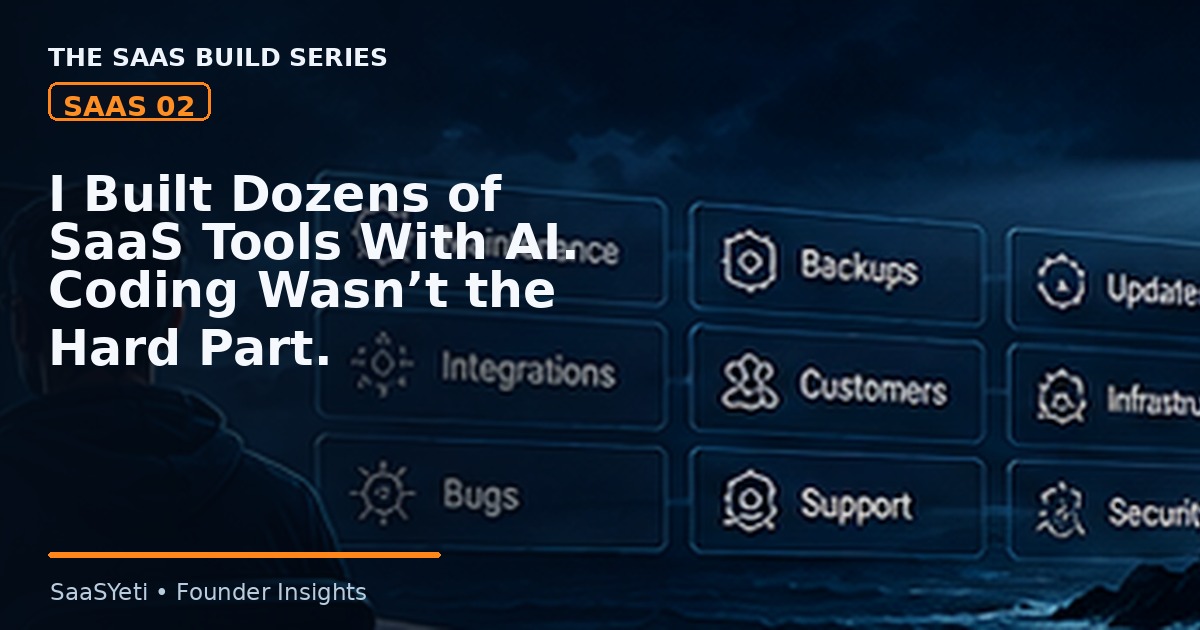
The moment an app works is not the finish line
AI has made me much faster at building software. An idea can move from rough conversation to database, login system, dashboard and usable application remarkably quickly. Features that once required days of repetitive work can sometimes be built, tested and revised inside a single working session.
But after building dozens of SaaS tools, I discovered that coding was not the difficult part. Keeping everything working was.
Every application that survives its first experiment starts accumulating responsibilities. It needs updates, backups, security, email delivery, API connections, database changes, user accounts, error handling, documentation, server resources and compatibility with everything around it.
The visible part is easier than the invisible part
AI is exceptionally good at helping with the visible parts of a product. Ask for a dashboard and you can get something impressive. Ask for an admin area and one can appear quickly. Ask for a feature and before long you are clicking it in a browser.
Maintenance is different. Nobody looks at a website and congratulates you on a beautiful backup strategy. Users do not know that a failed deployment rolled back correctly. They should not have to know. Good maintenance is invisible, but the invisible work is what keeps the visible product alive.
Every new app creates another responsibility
When software development gets faster it becomes tempting to measure success by how much you can build. Ten applications sounds better than five. Twenty sounds better than ten. The problem is that every application adds another operational obligation.
- database
- configuration
- domain or subdomain
- API credentials
- users
- email behaviour
- update history
- dependencies
- backups
- bugs
The question stops being “Can I build another SaaS?” and becomes “Can I responsibly own another SaaS?” Those are very different questions.
The question stopped being “Can I build another SaaS?” and became “Can I responsibly own another SaaS?”
Version control became a product feature
When you only have one small project, version numbers can feel administrative. When you are running many applications, they become essential. Suppose an application works this morning, you install an improvement and something unexpected breaks. Now you need to know exactly what version was running, what changed, whether the database changed and whether you can return safely to the working state.
That is why controlled patch management, version history and rollback became recurring features in SaaSYeti applications. They are not exciting marketing material, but once you manage multiple products they become some of the most valuable features you can build.
Backups are boring until the day they are not
When everything is working, backups feel like time that could have been spent building something new. Then something goes wrong and a backup suddenly becomes the most important feature in the system.
AI-assisted development encourages rapid experimentation, which makes backups even more important. A developer snapshot is not simply an archive. It is a checkpoint: a moment when the application is known to work. Ironically, the ability to move quickly becomes much more useful when you also have a reliable way to move backwards.
Integrations create invisible dependencies
Individual SaaS applications rarely stay individual for long. One tool needs email. Another needs customer information. Another needs authentication. Another needs access rules. Soon the products begin talking to each other.
An integration that works perfectly today can fail because an API response changes, a token expires, a field is renamed, a permission changes or a database structure evolves. The software that fails may not even be the software that caused the problem. The more useful the ecosystem becomes, the more relationships there are to protect.
The server does not care how quickly AI wrote the code
AI-generated software still runs on real infrastructure. CPU is real. Memory is real. Disk space is real. Network traffic and database connections are real. If an application creates a runaway process, the fact that AI helped write it does not make the server more forgiving.
This becomes especially important when several applications share infrastructure. A research crawler, background email process or AI job can affect completely unrelated services. Sometimes the correct engineering question is not “How do I make this faster?” but “How do I stop this damaging everything else if it misbehaves?”
The most dangerous feature can be the one you forgot about
A feature can be working perfectly and still become a liability because you have forgotten it exists. An old admin tool may remain accessible. An integration may still have credentials stored somewhere. A scheduled process can continue running after the feature it supports is no longer important.
Software does not automatically disappear when you stop thinking about it. Building more software therefore increases the value of knowing what you already own.
AI can help solve the complexity it creates
There is an interesting contradiction here. AI helped make this complexity possible, and it can also help manage it. It can inspect an application snapshot, explain unfamiliar code, compare versions, suggest migration strategies, document systems and identify duplicated features.
At the beginning, much of my AI usage was “help me build this.” Increasingly, the question is “help me understand what I have already built.” For a growing software portfolio, that can be considerably more valuable.
The real constraint changed
Before AI, the largest constraint might have been the amount of software I could physically create. That constraint has moved. I can now create considerably more, so another constraint becomes more important: attention.
There is only so much software one person can understand deeply at the same time. Only so many products you can monitor and only so many user experiences you can improve. AI can multiply output. It cannot multiply the number of hours in a day.
The new definition of fast
I used to think fast software development meant getting from idea to working application quickly. I still value that, but my definition has changed. Fast now means being able to make a change without being afraid of what it might break. It means knowing I can restore the previous version, knowing what depends on the component I am changing and having enough documentation to understand the system again months later.
Creating software is getting easier. Owning software is not. That is where the real work begins.
Creating software is getting easier. Owning software is not.
If I had realised this earlier
If I were starting again, I would put more operational structure in place before allowing the application count to grow. Every product would begin with a version number, a known backup method, a developer snapshot facility, a defined upgrade path, migration handling, useful logs and a record of external dependencies.
I would also ask a harder question before starting another standalone application: could this be a feature of something I already have? One extra application never looks like much on the day it is created. The cost appears later when the same capability has to be updated, secured and understood in several places.
Mature software development is therefore as much about subtraction as creation. Sometimes progress means deleting something, merging two applications, refusing a feature or spending a day making restore systems boringly reliable. That is not slowing development down. It is what allows development to continue safely.
This founder series documents the practical realities of building, operating and evolving SaaS products with AI — including the mistakes, maintenance and changes of direction that polished launch stories usually leave out. Follow the wider SaaSYeti Journey or see the community influencing what gets built next.